April 26, 2012

Albuquerque and San Andres

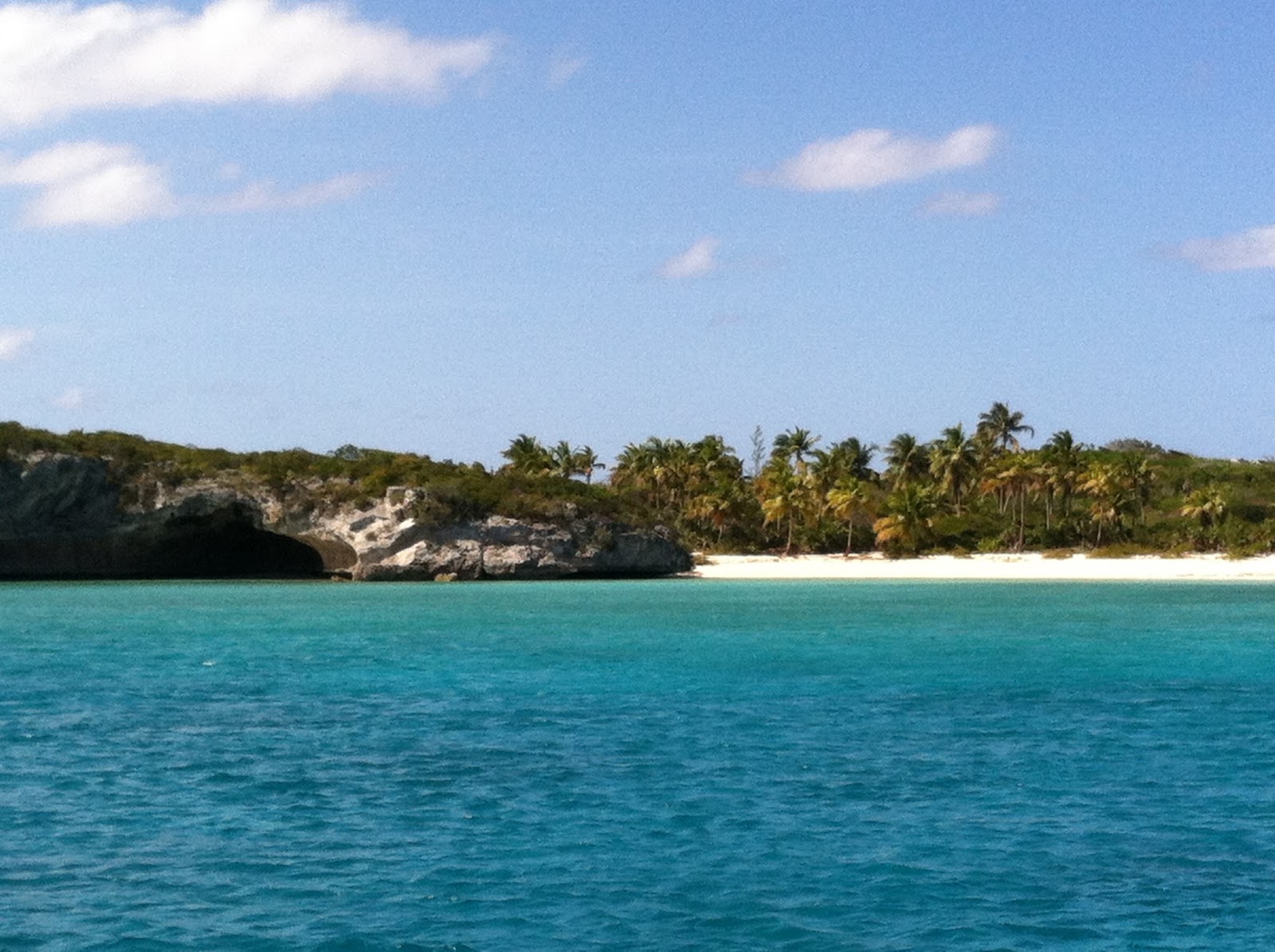
It was a perfect day in Bocas (clear, sunshine, vivid colors on the water and on the hills) for our departure to the Colombian islands of Albuquerque Cays and Isla San Andres. We are buddy boating with another Catamaran (Vida Libre) and their crew of three.  We met Dana who owns Vida Libre in Puerto Vallarta some years back and her crew will be Sam (Australian) and Kalia (Panamanian) who were just married last month and are on their first sailing trip. The two boats motored out of the Bocas anchorage on a Thursday afternoon for the first leg of our trip to Guatemala. We expected to reach Albuquerque in about 40 hours, rest for a day or two, and then sail a leisurely day sail to San Andres. The first night had us sailing to windward, and it was  bumpy and rolling, but the following day the seas calmed and we sailed along comfortably. Albuquerque Cays turned out to be a gem (a decidedly turquoise gem). We arrived in the AM and worked our way through the reefs and coral heads to a beautiful anchorage near the northern most of the two small cays. We are in Colombia.

P1010089 P1010118

P1010105P1010098


The southern island has only a few fishing shacks ashore, but the small northern island (about the size of the backyard where I grew up) is occupied by a Colombian Navy unit. Eight very young sailors and a commandant who must have been almost 25 years old are defending this island from God knows what. They are rotated out every 30 days, and there are actually several sand bagged, machine gun bunkers from which they maintained that they could repel any invaders. I think they are worried that if the island is left unoccupied that it will fall into the hands of the Nicaraguans (the island is much closer to Nicaragua than to Colombia), but only a few fishermen and about 20 sailboats manage to arrive here each year. The uniform of the day for the marines was black tees, black bathing trunks and flip-flops, and all of the sailors were friendly and apparently very glad to have company.

P1010097    P1010101

We walked their island, snorkeled on the ocean reef, and collected fresh conch for dinner (a highly overrated delicacy). I also attempted to set up my new hammock on the bow for the evening. I dreamed of fresh breezes while I swayed gently back and forth over crystal clear waters. Or so I thought. I got the hammock slung about 4 feet above the deck and climbed in. A slight sideways motion on the boat started the hammock swinging, gently at first, then building momentum. By the time i screamed for Andrea to save me I was swinging in an long arc about four feet left, then four feet right, with no way to grab anything to slow myself down. Andrea might have been a little quicker to help if she hadn’t been laughing so hard.

A weather forecast of high winds to come got us moving the next morning for San Andres. We had a beautiful spinnaker sail for most of the 25 mile trip to San Andres arriving just before dark. San Andres is a resort island for the Colombian mainlanders (sort of a mini Hawaii). The island’s economy revolves around the water sports, tour boats, and scooters for the tourist population. It is hard (impossible) to describe how clear the water is in this part of the world (to call it swimming pool water or bath tub water would be a disservice), and San Andres is a popular snorkel and dive spot.  The main town is clean and modern, but the island is small.

P1010135P1010151

There is a considerable Jamaican influence, but Spanish is the language, and we may very well be the only Americans on the island. We rented a golf cart to tour the island and made a complete circumnavigation in about 4 hours with stops along the way for beers and coconut drinks. The rental manager was very impressed that I already knew how to drive a golf cart.  Now I know where old Club Cars go to die. Our first view of Colombia is very favorable.  Everyone has been very friendly, the stores are modern and full of goods for sale, the music is loud and raucous, and the prices are suited to tourists (a little high) though a bottle of Colombian beer only costs about $1.50 at the bars. 

  P1010165  P1010127

We are settled here for a few days waiting for a good weather window to sail to Providencia 60 miles to the north. Winds have been blowing 15 to 25 knots from the north since we arrived, and the seas are up, so we will wait patiently for a good opportunity to sail this final short leg before setting off on the long trip to Guanaja and Roatan.

P1010214  P1010100

April 19, 2012

Full Speed Ahead

Yes, this voyage is underway and by the time most of you see this e-mail we will be well out to sea. We are planning on floating out the Bocas del Toro channel at 3PM Bocas time (EST) bound for Albuquerque Cays (175 mi.), San Andres (25 mi) and Providencia (60 mi). These are all Colombian islands in the Caribbean . With any luck this will be a 35 to 40 hour sail to Albuquerque . We realized that our long stay in Panama has had us sailing within sight of land ever since we entered Panama on the Pacific coast in December 2009, so we are just a little apprehensive. Is the boat ready? Are we ready? What can possibly go wrong? We’ll see.

We skipped town early this year (April 12) leaving the office busy with last minute returns, but sticking to our plan to work less, sail more. With multiple experiences flying the SFO to Panama route we managed one of our easiest trips. Quick connections, zip through customs, familiar hotel and casual dinner. After an early morning flight from Panama to Bocas we were rewarded with a spectacularly beautiful morning with flat seas, bright sunshine, and a cool breeze. We ate at a small, waterfront café and then took a slow boat ride to the marina to “de-winterize” the boat.

Three days of intermittent work and beach trips had us ready to move to the Bocas anchorage and start provisioning for the trip. The only fly in the ointment was our inability to install the new solar panels. They turned out to be too heavy for the planned installation, but it took a lot of work to get to the point where we realized that. My panels are turning out to be a lot like my friend Keith’s salmon boat: big investment, no return. Keith has the boat in his front yard masquerading as a lawn ornament. My solution was to sell one of the panels and keep “planning” for the other.

Our final night at Red Frog was a beach barbeque at the “tent resort” with friends. Good food, cold beer, and a pleasant reggae band made for a suitable send off from our home away from home. From now until early June we will be sailing to a series of small cays, ocean reefs, uninhabited islands, and larger islands with small towns. We will carry most of our food and beverage, provisioning with fresh items when available. The beer bill was staggering, but we should be able to manage almost two months afloat without starving to death.

Very hopefully you will be hearing more about this trip soon.

Tom & Andrea

If you are following on Google Earth the first half of the trip looks like this: First stop Albuquerque Cays 12° 9.986'N, 81° 50.569'W then San Andres 12° 34.706'N, 81° 41.526'W, Isla Providencia 13° 22.790'N, 81° 22.439'W, Low Cay 13° 31.142'N, 81° 20.054'W, Quito Sueno Bank 14° 18.691'N, 81° 12.790'W, and then 160 miles to Vivarillos 15° 50.010'N, 83° 18.270'W

February 15, 2012

Guilty Pleasures

Mea culpa, mea culpa. I have been guilty of total non-communication over the past several months and I apologize. We have had so many e-mails wondering if we are home, traveling, sailing, working, golfing, etc., and we have failed to respond. Incommunicado. Bad people.

Yes, we sailed in Panama from early November until almost February, and we are back in CA working (towards retirement) while we plan our next adventure afloat. We spent the three months in Bocas del Toro, Panama enjoying good winds, pleasant anchorages, white sand beaches, small bars, cheap beer, rain, bugs, humidity, running aground, swimming with jelly fish (even paradise isn't perfect), and having a good old time. Of course that is very much what we had done the previous two trips south so I got a little bored with the blog and ignored it for a while. But no more.

When we first arrived in Panama in 2009 we had intended to spend just 3 months in the country before moving on. Instead we just spent our third Christmas in Panama which should tell you something about how much we enjoy the place. The trip was great, but we are now home (cold), and I am making an effort to catch up on the mail.

The boat is in great shape with new sails, new motors, new windows, a smaller bank account, etc. We are ready to move on, but the crew is reluctant to leave such a pleasant place as Bocas del Toro for the open ocean trip north. We have made a lot of friends there, both liveaboards with their own sailing plans, and ex-pats who have chosen Panama for their retirement, and we have enjoyed the frequent gatherings on beaches or in restaurants or on other boats. This we will miss.

We are planning on flying back to Panama in early April, and the goal (I won't use "sink or swim" to describe our determination) is to leave the boat in Guatemala at the end of this trip. We have new solar panels to install when we return and a new GPS sitting here in living room, but then... off to greater adventures.

The trip from Panama to Guatemala will take us several weeks. We will cover about 900 miles of ocean travel with stops at small islands and reefs to break up the passage. The first leg of the trip will be moving north from Panama to the Colombian islands of San Andres and Providencia. These islands are some 250 miles from Bocas del Toro and about 100 miles off the Nicaraguan coast. From there it is on to the Hobbey Islands and Roatan in Honduras. The leg from Providencia to Roatan is about 400 miles and would take about 72 hours of continuous sailing, but we plan to spend several days along the way enjoying some uninhabited islands and coral reefs. Hopefully we will also be spending a good deal of time in Roatan before we have to seek shelter from the summer hurricane season in that part of the Carribbean. One of the nice things about Panama is/was... no hurricanes!

From Roatan we will sail another 200 miles to the Rio Dulce River in Guatemala where we will head upriver about 20 miles to hide out for the summer. Of course we will be back in CA for golf and farming by late June while the boat rides out the storms in the river all by itself. All of these islands and the Rio Dulce River are supposed to be beautiful and we are looking forward to the new scenery, but the trip will involve a lot of travel. Because we have been lying idle in Panama for so long we have almost forgotten the rigors of an ocean passage. Still we are both looking forward to being under sail for days at a time. AND.. we hear that the Rio Dulce is a social hotspot for cruisers in the Carribbean, but more on that later.

I absolutely PROMISE to do a better job with e-mails and updating the blog in the spring. It should be a little easier because our trip will be a little more adventuresome than just sitting in some palapa bar sipping mai tais... or will it?

Tom and Andrea

June 7, 2011

Sailing Bocas

The Spring Fling aboard Mañana began a little earlier than usual this year. We are trying to work a little less each winter (my concession to retirement without actually retiring) so we blew town very quickly after tax season to resume our trip. This spring is turning out to be one of the best trips we have ever had on Mañana, maybe because we haven’t actually gone anywhere. We had planned on a return to San Blas for a few weeks and then a long sail (450 miles) to Isla Providencia (Columbia) and on to Roatan and Guatemala. Early rains kept us in Bocas for an extra week and then our dinghy motor died, so we stayed another 2 weeks while we moved from fixing an 11 year old outboard to treating ourselves to a brand new outboard. As the weeks slipped by we realized that maybe two months exploring the Bocas archipelago was all the sailing we would be doing this spring. Great decision!! We have been moving from one picturesque anchorage to another, exploring reefs and snorkeling, meeting transplanted Americans who live ashore in the Bocas area, treating ourselves to breakfasts and dinners ashore when we are in town, and generally loving the lazy life.

IMG_2998 IMG_3009

Not that paradise is all, well… paradise. We did find that flying termites had discovered our boat while we were gone. Termites make holes and holes on a boat are “not good”. We were surprised that they would attack a fiberglass boat, but they had evidently found their way into some of the wood core between the fiberglass. Evidence of droppings and some live critters has had us spraying in some very inaccessible places on the boat in an effort to get rid of them quickly. We appear to be termite free at the moment and we have our fingers crossed.

IMG_3013 IMG_3015

We decided to buy a new dinghy motor rather than continue to repair the old one. We reasoned that Panama was the best place to get a new motor in Central America, and after all, we are leaving Panama soon, right? A call to Panama City found exactly what we wanted and a cheerful, English speaking sales person said he could ship in just two days. Well with credit card processing, actually finding the motor, shipping, etc two days turned into two weeks or “mañana” as they say. When the trucker finally called to say he was leaving Panama City and would be on the morning ferry from Almirante to Bocas (remember, Bocas is on an island) we were ready. We met the ferry in Bocas, looked for our truck, and… nada. Not there. Several phone calls later we learned that the truck had missed the ferry because of a strike on the Pan American highway, but “not to worry”, he was now at the ferry terminal and “mañana”, etc. So bright and early the next morning we again meet the ferry looking for our truck and, again, nada. No sign of him. Of course I have complete faith that our $1700 motor is just around the corner, but Andrea is beginning to get a little skeptical. Then this little Panamanian walks off the ferry, asks for Tom, and quietly explains that “Yes, your motor is on my truck. Yes, my truck is on this ferry, but… I have left my keys in Almirante. I can’t get off the ferry. So we waited while a fast water taxi was dispatched from Almirante to bring the keys. An hour later here comes the truck rolling off the ferry, but, of course, there is one more small problem. The truck is padlocked and the water taxi only brought the ignition keys. The fellow left us for another half-hour while he went in search of bolt cutters to cut the lock on his own truck to deliver our motor just two weeks (not two days) after we ordered it. Ah, Panama! Good new is it works great!

IMG_3054 IMG_3077

Bocas is boat life. There are no roads except on the island of Colon and water taxis, private pangas, small dinghies, and sailboats not only abound, but they are the only transportation in the area. The local Indians still paddle their canoes everywhere, and the contrast between the motorized community and these tiny log dugouts is striking. We have been guests at a Panamanian birthday party (the party was on an island in a small palapa with 6000 watt speakers playing Spanish rock and rap. The music system had no volume control, only on and off. On, full volume, off, no volume. In case you are wondering “off” was not an option). We toured a cacao farm hidden in the rain forest, we have found poison dart frogs in brilliant red, green and blue colors (we have tried “not” to find the deadly fer-de-lance snakes that roam the same forests), we grounded the boat in just 2 feet of water (then got out and pushed ourselves off the reef), and we have had the opportunity to visit some very remotely located homes of people who have chosen to live in Panama well off the beaten track. There are many, many reefs with good coral, small fish, and turquoise waters to keep us happy afloat. We sail often and we change anchorages almost daily looking for the best beach or the best reef or just the best bar, and occasionally we wander into town for ice cold $1.00 beers at the Riptide or the Pickled Parrot. (We have avoided the blended “boat drinks” at the Parrot because of the many small geckos that crawl over the blenders searching for a way into the juice.)  Our favorite pastime may be just sitting on the bow of the boat with a couple of beers enjoying the breezes and the sunsets and thinking how lucky we really are.

IMG_2935IMG_2928

The weather this spring has been great. A little hot by California standards, but since we are just 600 miles from the equator that is to be expected. Steamy days and lots of sunshine are often accompanied by frequent rain showers and cooling breezes in the evening. Occasionally we do get a little more rain or fewer breezes than we want, but you can’t have everything… can you?

Hasta Mañana,

Tom and Andrea

January 21, 2011

January 2011

We left the San Blas islands on Jan 3, 2011 in big seas (10’ swells) and strong winds (20 - 25 knots). We had expected a little better weather, but I think we jumped the gun by one day and caught the tail end of a weather disturbance. It took us an hour or so to get used to the following seas, but once we got moving it was a surprisingly quick trip to Isla Linton with reefed sails and wind on the beam. We cruised through Isla Grande and into Linton where we found a pleasant spot to anchor just a few hundred yards from the Dutch restaurant on the beach. We spent a very pleasant evening letting someone else cook for a change, and the seafood dinners were outstanding.

The following AM came up sunny, warm, and breezy. On what was certainly the best sailing day of the entire trip we mistakenly opted for a short, late AM sail to Portobello. We should have gone straight to Bocas (24 hours) taking advantage of the conditions, but we were curious to see the changes in Portobello (a new bar called Cap’n Jack’s), and the damage from the recent rain storms (two sunken boats and large landslides). We enjoyed the sail but moved only 20 miles for the day, and later we would regret not having moved on more quickly.

We struck out for Bocas early the next morning with very good winds and sunny skies. We moved along at an incredible pace all afternoon, and we actually talked about when to slow down so we would not arrive in the dark because we were sailing at 8 to 10 knots all day. Oh that we had left one day earlier. At dusk winds shifted to the nose, the current ran foul, and we motor slogged our way through night battling current, wind, rain, and waves. The boat was bouncing and slamming on the waves and on the whole it was one of the darkest, most unpleasant nights aboard. Even when land was sighted the next AM we still had hours of motoring ahead of us because the current was running over 2 knots against us. Poor planning on our part.

Tom’s sister, niece and her husband (Sharon/Anya/Lukas) were waiting in Bocas when we arrived. Sharon is moving to Costa Rica and needed to vacate the country after 90 days as part of her visa so they hopped aboard the bus in San Jose for the all day trip to Bocas via bus, foot (across the border and the rickety foot bridge at Sixaola), taxi, and then water taxi. This was a pleasant visit because we got some shore time visiting restaurants and bars and later they got some sailing and a visit to our Red Frog beach for their 4 day trip. We also visited the most remote restaurant I have seen in some time. Despite the mantra that “location, location, location” is so important to any restaurant the Rana Azul (Blue Frog: named after the tiny poison dart frogs that populate the area) is an Austrian pizza restaurant accessible only by water (nearest road 8 miles through the jungle and a 1 to 3 hour boat ride from Bocas depending on whether you are traveling by water taxi, fast dinghy or sailboat). They are only open Friday and Sunday, and they draw a surprisingly good crowd. Yes, they have stone pizza ovens. Joseph and Maria were cruising when funds ran short and they are rebuilding their cruising kitty with good pizza and great Mojitos in a very strange, very beautiful location.

January 2, 2011

San Blas Blues

We spent the month of December enjoying the unbelievably picturesque San Blas Islands (called Kuna Yala by the native Kuna Indians) despite the fact that the entire area has been deluged with record rainfall.  In what is normally a very wet country this month has been exceptional. The Panama Canal was closed due to high water levels in Lake Gatun for the first time in history, the only road to Kuna Yala (a four wheel drive route to Carti) was/still is closed, several small boats have been destroyed in the storms, and the small planes that service the Kuna Yala airports have been grounded. Supplies have been extremely scarce because even when the single road is in service most of the goods available in Kuna Yala arrive via small trading boats from Colombia. With the wind and rain we were in a truly isolated part of the world.

We did have days of full and partial  sunshine so we were able to sample the snorkeling, take island walks, swim in aquamarine waters, and we had several days of excellent sailing, but many nights and early mornings we got pounded with rain.  Twice we had to retreat from the outer islands, which are exposed to the high winds and the seas, and find shelter along the coastal mainland. Most of the outer islands consist of long barrier reefs and small sand islands with palm trees.  The reefs break the big waves protecting us from the worst of the seas, but they offer no protection from the wind.

IMG_2847 IMG_2740IMG_2781

We sheltered in Bahia Nalia for four consecutive days of rain early in the month, and then again a few weeks later for four more days behind the island of Nargana.  Those were grey days indeed with not much to do except read and play cards.  Even visiting other boats was a wet experience, and everyone complained of cabin fever. In Nalia we bought lobsters and fish from the Indians (but we did very little swimming after one of the other boats sighted a large crocodile sharing the anchorage), and we watched as the Kuna came out in little log canoes to fish even in the hardest rains. Their fishing technique was very entertaining.  With two people in a each tiny log boat the bowman literally “throws” a hook and line into the water and then retrieves the line very quickly, hand over hand, to catch the larger fish feeding from below. The second man maneuvers the canoe while also flinging cups of water from the canoe to create a pattern of bait fish jumping where the hook is being thrown. It really works.  We watched fascinated as the native Kuna pulled in several fish using no bait on the hooks.  As each fish is retrieved the bowman, standing precariously in the log canoe, unhooks the fish, flings the hook back into the water, bangs the fish twice on the side of the canoe to stun him, drops the fish in the bottom of the canoe, and then frantically retrieves the hook again.  Fresh fish has been a big part of our diet (along with beer and rum), and I mean really fresh fish.

IMG_2856   IMG_2686IMG_2779

Most of the islands in San Blas are very small and almost entirely uninhabited except for a few small fishing huts.  The islands that are inhabited are very crowded however. Wichibhuala and Nargana were two of the larger islands, and Nargana even had a generator supplying the town with electricity. There is no running water, but TV antennas abound and cell phones are common. The Kuna who live on islands without generators will paddle out to the sailboats and ask to have the cell phones plugged in to recharge them.  We even found internet access at the elementary school in Nargana. Both Wichibhuala and Nargana were crowded with thatch roofed homes that also served as shops to sell various supplies and hard goods imported from Colombia. The two islands seemed to be near the bursting point for population.   Originally the Kuna moved to these islands to avoid disease and other populations on the mainland, but today they are beginning a reverse migration back to the mainland.

IMG_2707 IMG_2706

The Kuna are very small people (we read that only the pigmys are a smaller in stature) and extremely friendly. They always introduce themselves and ask your name.  The Kuna are a matriarchal society (the women run everything) and the women over 18 wear very colorful native dress (molas, skirts, head bands and beaded leggings), while the men seem perfectly contented with shorts and tank tops.  The molas are intricately sewn cloths that the women hand stitch and sell in the markets throughout Panama. Andrea tries to cheer me up constantly when it’s raining so one day she told me of plans to visit “Bug Island” (sound good?), another day she wanted to snorkel on a reef known for its white tipped sharks (sound safe?), and finally she hit a real highlight with promises that we would soon be meeting one of the islands’ most famous Kuna mola makers… a transvestite named Lisa (sound like fun?). Lisa turned out to be a large and very attractive, uh…  Well, if only the women can make and sell molas then I guess a guy trying to crash the party needs his own schtick .  She/he made nice molas though.        

IMG_2822                                 

We have many new friends afloat and we do beach parties and boat parties regularly.  We had an impromptu concert when four guitars appeared at a birthday gathering.  We celebrated our Christmas Eve anniversary with late night guests aboard Mañana, and Christmas Day was a festive pot luck on a much larger catamaran.  We found a small bar run by a man named “Yogi” that sold $1 beers and $1 wines from a thatch hut on an island beach, and once again the cruisers’ guitars provided the entertainment. We watched the rare full moon eclipse that occurred around 3 AM on a clear mid December night from the trampolines on the bow, and we spent New Year’s Eve with about 30 people on a deserted island in a  beautiful anchorage called the “Swimming Pool”. I will let you imagine how beautiful and peaceful  an anchorage with a name like the “Swimming Pool” can be. We  buy gasoline strained through a T-shirt. We buy vegetables from a small boat that buys vegetables from a big boat, that buys vegetables in Colombia. We buy fish from the natives. Life is good.


IMG_2739 IMG_2624

We did not get to do or see many of the things we had hoped to because of the wind and rains so we think we will return to San Blas/Kuna Yala again next spring.  This was still a good trip despite the rains, and the San Blas Islands are indeed spectacular enough to warrant another visit. Tomorrow we start the return trip to Bocas where we will leave the boat for the winter and head home to CA.  

Tom and Andrea

December 2, 2010

Bats, Monkeys and Rain

We celebrated Thanksgiving on the dock at Red Frog with some 40 other cruisers with smoked turkeys and pot luck side dishes.  Only about a third of the cruisers here are Americans, but the several other nationalities had no trouble participating in this distinctly American holiday. On Friday AM we dropped the lines and sailed leisurely towards Crawl Cay for our departure anchorage.  Saturday AM we would get an early start for the 36 hour trip to our next anchorage so we were looking for calm waters and a restful night and the aqua blue waters in the lee of Crawl Cay (9°14.600'N/82°8.400'W) were perfect.

 IMG_2618   IMG_2608

Overcast and grey greeted us at dawn, but we were anxious to sail so we ignored the less than perfect conditions and motored out into the sea.  By 10 AM we were being seriously bounced and rolled and looking at black clouds ahead.  Torrential rains hit and made visibility non existent so we decided to head for a charted, sparsely inhabited island for a little respite from the wind waves and water.  Even in the lee Isla Veraguas (9°5.754'N/81°34.446'W) was rolling heavily, and after only a short nap we opted to continue on despite the rain.  We upped anchor at 4 PM and again headed out for the inevitable all night sail.  The following dawn found us approaching Colon, but much of the trip was with the sails down in heavy, rolling seas. We continued on another 40 miles to a calm anchorage at Buenaventura (9°32.021'N/79°40.517'W) arriving some 33 hours after leaving Crawl Cay, and again acknowledged that over night trips are just not our cup of tea. We slept well however in the lee of a massive hillside that blocked all wind and seas.

More rain in the morning, lots more rain, so we scuttled plans to sail the final 50 miles to San Blas in one leg and instead made a late afternoon jump to Isla Linton (9° 36.795'N/79°35.084'W) (about 12 miles) and another familiar anchorage.  Remember we had gotten this far last year before our wire rigging parted and sent us scurrying back to Shelter Bay so we already knew of a couple of safe spots to stop.  Linton was notable this time around for the screaming of the howler monkeys at dusk (sounding very much like the fiercest of dragons in the woods) and for the swarm of bats that attacked the bunch of ripening bananas that we had hung from the solar arch. Starting shortly after dark and continuing until early AM these large bats kept dive bombing the bananas and then swooping through the cockpit.  We could do little but sit and watch since I did not want to spend time untying the bananas and moving them with so many bats around.  I really didn’t want to upset them.


Overcast again in the morning so we selected another anchorage to aim for and headed out once more.  We still had wind on the nose, rain squalls, and rolling seas and once more we chose to stop in the early afternoon.  We found a peaceful anchorage inside some reefs in just 6 feet of water at Escribanos (9°33.068'N/79°9.386'W). The particular feature of this anchorage was the remoteness.  We were the only boat in the area, we were tucked into a large mangrove lagoon behind the reefs, and there were absolutely NO LIGHTS visible in any direction. On a moonless night it was as dark as anything I have ever seen.  Even the water under the boat was invisible. Eerie.

Finally, on the 5th day of our two day trip we reached the San Blas and the island of Porvenir (No more Lat/Lons in this blog because Google does not have very good resolution for this area) where we would check in with the local Port Captain and the Kuna Yala comarca.  The native Kuna Indians “own” the islands as an independent comarca (think state) of Panama. Three tribal chiefs control the islands, and it is with their permission that we can anchor here. When we arrived we paid the first chief $24 to be able to anchor near his islands. Porvenir itself has an airstrip with a short (very short) runway built by the Americans in World War II , and there is another small airstrip further east, but the San Blas area has only a single four wheel drive road for land access. The road crosses a river (sans bridge) along the way and it is frequently closed making this a difficult place to reach except by boat. The runway at Porvenir is about twice as wide as my driveway and not nearly as smooth so I can imagine what the road must look like. The rudimentary runway with palm trees on each side coupled with the reefs all around the island make this look like the kind of place John Wayne would have been stationed in the Pacific.  While we were wandering across the runway, casually taking pictures, we were told to look up…  oops! Plane landing, time to move.

 IMG_2638IMG_2640

Our first San Blas anchorage was the Chichime Cays, two small islands set among the reefs which block the ocean swells from the North. The water was a pretty aqua blue even in the overcast afternoon skies, but the eeriest part was sitting in 15 to 20 knot winds with almost no waves because of the reefs.  It was a very secure feeling.  The two small islands are used as seasonal homes (fishing camps) for several Kuna families.  No running water, no electricity, no shelter other than the palm leaves that made up the roofs of the huts.  The Kuna fish in dugout canoes with nets and lines, and we saw at least one canoe with an infant and two pre-teens paddling between the islands. The Kuna are a truly water oriented culture. Several days after we left Chichime we heard that a sailboat had been blown onto the reef here (we have had some hellacious weather in the past week) and had to be abandoned.

IMG_2657 IMG_2648

We spent 3 days at Chichime walking the islands, snorkeling, and generally watching the rain squalls blow through the area.  Andrea got a chance to buy a “mola” from a Kuna selling (from his canoe) the intricately embroidered cloth that makes up a part of the traditional costume that all of the women wear. Among the Kuna the women run the families, have the largest voice in the community decisions, and still dress in the traditional garb with molas, dresses and fully beaded leggings. The men seem content in T-shirts and shorts which are most appropriate for the single industry here… fishing.

IMG_2653 IMG_2668

The past week has had but two sunny days and there are some bad weather forecasts for the coming week.  We will move on to other islands and hope that the weather clears soon. Did I mention that rainy season in Panama ends in November?  Hah! The next blog tells all.

Tom and Andrea